When I play,
I both hear and listen
I plan ahead and replay back
And at the same time…
It’s controlled momentum, the “here” and “now”
That allows elation to manifest itself in music
When I play,
In this moment-
As the bass pulls me underwater
The notes swirl through my hair
There is an energy produced that softly envelops you and I
Now we are one
My body surrenders
It moves at whim now
The beat is now pulsating ripples
rhythmic waves that clash on and on and on
And as soon as I let go,
I am carried far away
My emotions at the mercy of the riptide
But a note amiss and ahh
I am called back
Back to my audience
Back to the people taking pleasure in my internal torment
memories unfolding through shaking hands
And I tell them,
in my not so silent way, that tumbling is what it takes to navigate a storm
Category: blog
The Sight-Reading Challenge, a Reverse Approach
Asking a young child to sight-read can often be a difficult task. Parents with a child in music lessons can get frustrated because the child lacks the motivation to read/play what was assigned or they often forget which notes are which on the staff. The students can become frustrated with themselves as well, and this is a slippery slope. As negative emotions well up, the child becomes less motivated, and the less effective the piano practice. The best student is a happy student!
While there are many note reading methods and games, they all boil down to the same approach. A note is presented and the student is asked to name it. If the student is struggling however, perhaps the approach needs to change.
Here are some important things to remember during practice with your child:
Play Children learn through play. Make anything and everything a game.
Simplify you cannot add more until they feel empowered about something they have already learned. The real progress begins when a child sees his/her own growth and feels competent in what he is learning. It’s important to tap into their internal motivation
Create children are always being told exactly what to do, they are copying so much in the developmental ages of 3-10. Should a student start to “shut off” and you feel like as you speak nothing is getting through, the best antidote is to ask them to be more involved in the actual learning process. Get the child to have an input in how they will achieve their own learning goal. This teaches them that they too are responsible for their own learning success. A motivated child will learn and retain 10x better than a child who feels inadequate and is eager to escape the lesson.
Try this:
Ask your child to create a song (any combination of notes will do) and as they choose each note, ask them to write it down. Then ask them to play back their song. Keep it extremely positive and easy for them.
Here is a link to sheet music you can print out: https://b570f299d8a96ff32c59-2e725a51007a5cce3182c57bd45640f2.ssl.cf1.rackcdn.com/pdf/grand-staff-paper.pdf
This is a creative activity! So don’t add pressure but keep it as light and fun for your child as possible. I’ve noticed a huge improvement with my students after using this activity.
Major vs Minor
Children as young as 2 1/2 years old can begin to identify Major and Minor keys with their ears. Here’s a fun activity to try:
Basically any music we hear in the western world is written in a Major or Minor key. It’s a way of grouping music based off of its scale (a scale is a certain selection of notes used for a song).
When young children begin to hear and notice the difference between the two keys, it’s a huge step in advancing their musical ear training.
How to do it:
• Play these examples of Major and Minor for your child below.
• Ask him/her to repeat the word “Major” after its example and “Minor” after its example.
• Now explain that Minor can sometimes make us feel sad or mysterious and Major can make us feel happy and courageous.
• Give big happy faces to each other as you play Major and make sad/scary faces as you play Minor.
• Once they seem to have that down, play a game by playing an example without them looking. Then ask them to show you the face that matches the example. Major-😊 Minor-😢👿
Get creative!
…you could assign roles and ask your child to pretend to be a princess or superhero etc. as they enter the room to the Major sounds.
Then you can pretend to be a witch or bad guy during the Minor example.
Lastly play Major again as the princess or superhero enters the room to save the day.
Finger Independence
Identifying and moving individual fingers is actually a really tough task for little ones. Yet it’s needed for learning most instruments. Build your child’s finger awareness and accelerate their musical coordination by singing this traditional song from Denmark, I tailored the lyrics to help my students memorize finger numbers for piano. They love it! This is Lilianna helping me demonstrate.
Loud versus Soft
Hearing the difference between loud and soft seems easy for a child to notice at any age. However identifying it and labeling it in a musical setting is an important skill. This is one of the activities my 2-5 year old students like the best:
*History* Haydn was a composer way back in the 1700-1800s. He was owned by a prince and was required to compose for the prince’s big parties. The guests however, would feast before Haydn’s premiere and fall asleep during the performance. Haydn decided to channel his irritation and practical joker tendencies into a song. Hence he composed his famous “Surprise Symphony” https://youtu.be/lLjwkamp3lI. This song gradually gets softer (diminuendo) to lull the audience to sleep. Then suddenly the horns blow loudly to scare the audience and wake them up.
*Music terms*
- forte- to play
- piano- to play softly
- diminuendo– to gradually play softer
- subito- suddenly
*Activity* Play this song for your child as you both pretend to fall asleep . Then suddenly “wake up” startled when the song gets loud.
This is a fun activity that also teaches children to listen for changes in music and notice how different sound effects impact the listener in different ways.
Identify the Speed of Music
A musical child will begin to hear and identify the difference between fast and slow and thereafter notice when a song speeds up (accelerando) and slows down (ritardando).
Try this:
Play a recording of Robert Schumann’s “Wild Horseman” https://youtu.be/qZ1OJyQYZzw and trot around the room to the fast rhythm. Talk about how this song makes you think of a horse because of its fast, galloping rhythm.
Next, contrast this with a very slow rhythm. I often choose Camille Saint-Saëns’ “Carnival of the Animals- Tortues (Tortoise)” https://youtu.be/wPHqJTpgo-U because of its dramatically slow tempo. Move or crawl slllooooowwwwlllyyy to this song pretending to be a tortoise. Not only learning about musical concepts but also feeling it in our bodies is the most effective way to learn, especially at this age.
Intermediate:
- Begin by marching together with heavy feet to give your child the idea of moving to a beat.
- Ask your child to march to the beat of your tapping (if available use a hand drum however tapping on any hard surface would work fine).
- Tap slow, tap faster, then really fast while they move as fast as they can. Transition between fast and slow. This teaches them body control in addition to rhythm.
- Then switch roles and ask him/her to tap and control your fast or slow movement around the room.
Playful with Pentatonic
If you have a piano or keyboard you will love this exercise with your little one. (Even a keyboard app on a tablet will work too)
Get your child creative with music while also subconsciously training their musical ear.
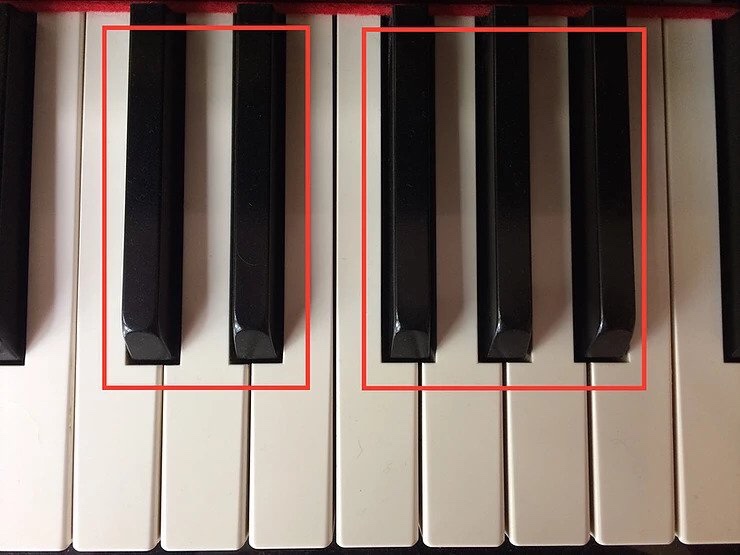
Ask them to play only the black keys
I love this activity because it teaches children not to be afraid of getting creative or playing notes that aren’t on a page. My students light up when they hear that they can create something on the keys, something that sounds pretty! It’s a nice break from lessons that require a lot of focus but it also teaches some useful skills in a way that’s pleasant on the ears and is good ear training for them as well.
When a child begins music education it:
- improves academic skills.
- develops physical skills.
- cultivates social skills.
- refines discipline and patience.
- boosts self-esteem.
- introduces children to other cultures.
Given the benefits of learning music, it is only natural parents that want their children to have every opportunity to develop musical skills and reap the results.
This however presents its challenges to the well meaning parent. As a piano and preschool music teacher, I took note of many teaching techniques that make music teachers successful.
This goes out to parents who:
• feel they have little to no musical ability or knowledge
• have children who are considered too young for traditional music lessons, yet still want their children to be involved in music
• have children who resist or struggle with piano practice
• are looking to diversify their child’s musical exposure
In this blog we will address how to begin incorporating music in the home and how to make piano practice more effective and enjoyable. Here to answer any of your questions and remedy challenges, this is Music Roots.